If you live in New Berlin and you have ash trees on your property, you already know something is wrong. The canopy looks thinner every year. Branches that used to leaf out by May are still bare in June. The woodpeckers have taken a particular interest in one tree near the driveway.
That’s emerald ash borer. And if you haven’t dealt with it yet, you’re going to.
What Does Emerald Ash Borer Do to a Tree?
Emerald ash borer (EAB) is a metallic green beetle, about the size of a grain of rice, that burrows under the bark of ash trees to lay its eggs. The larvae feed on the inner bark, cutting off the tree’s ability to move water and nutrients. Over two to four years, the tree starves from the inside out. By the time you notice crown dieback or bark flaking, the damage is already extensive.
EAB was first confirmed in Wisconsin in 2008. Waukesha County has been dealing with active infestations for over a decade now, and the southeastern part of the state has been hit especially hard. The Wisconsin DNR has released biocontrol wasps in several counties to slow the spread, but “slow” is the key word. In areas with established infestations, healthy ash forests lose up to 98 percent of their trees within six years.
Why Is New Berlin Hit So Hard by Emerald Ash Borer?
New Berlin’s tree canopy took shape during the residential building boom of the 1980s and 1990s. Developers planted ash trees heavily during that era because they were cheap, fast-growing, and reliable in Wisconsin’s climate. That means entire neighborhoods along the Coffee Road corridor, through Hickory Hills, and into the subdivisions near Calhoun Road are dealing with ash trees that are all roughly the same age and all vulnerable at once.
When one ash tree on a block starts showing signs of EAB, the beetles don’t stop there. They spread to neighboring ash trees within the same season. That’s why you’ll sometimes see three or four dead ash trees on the same street while the next block over looks fine. The infestation moves in waves.
How Do You Know If Your Ash Tree Has EAB?
The earliest sign is canopy thinning that starts at the top of the tree and works downward. You might also notice:
Increased woodpecker activity. Woodpeckers feed on EAB larvae and will strip bark to get at them. If your ash tree suddenly has patches of missing bark high up, that’s not random.
D-shaped exit holes in the bark. When adult beetles emerge, they leave small holes shaped like the letter D. These are hard to spot from the ground but unmistakable up close.
Epicormic shoots. The tree sends out desperate new growth from the trunk or lower branches, trying to compensate for the dying canopy above. These shoots look like small leafy sprouts growing directly from the bark.
S-shaped galleries under the bark. If you peel back loose bark, you’ll see serpentine tunnels carved by larvae. At that point, the tree is already in serious decline.
Should You Treat or Remove an Ash Tree with EAB?
There are chemical treatments that can protect ash trees from EAB, but they work best as prevention, not rescue. If a tree has lost more than half its canopy, treatment is unlikely to save it. The injections need healthy vascular tissue to distribute the insecticide, and a heavily infested tree doesn’t have enough left.
If your ash tree still has a full, healthy canopy and you want to keep it, preventive treatment is worth considering. It requires retreatment every two to three years, and it only protects the individual tree, not the ones next to it.
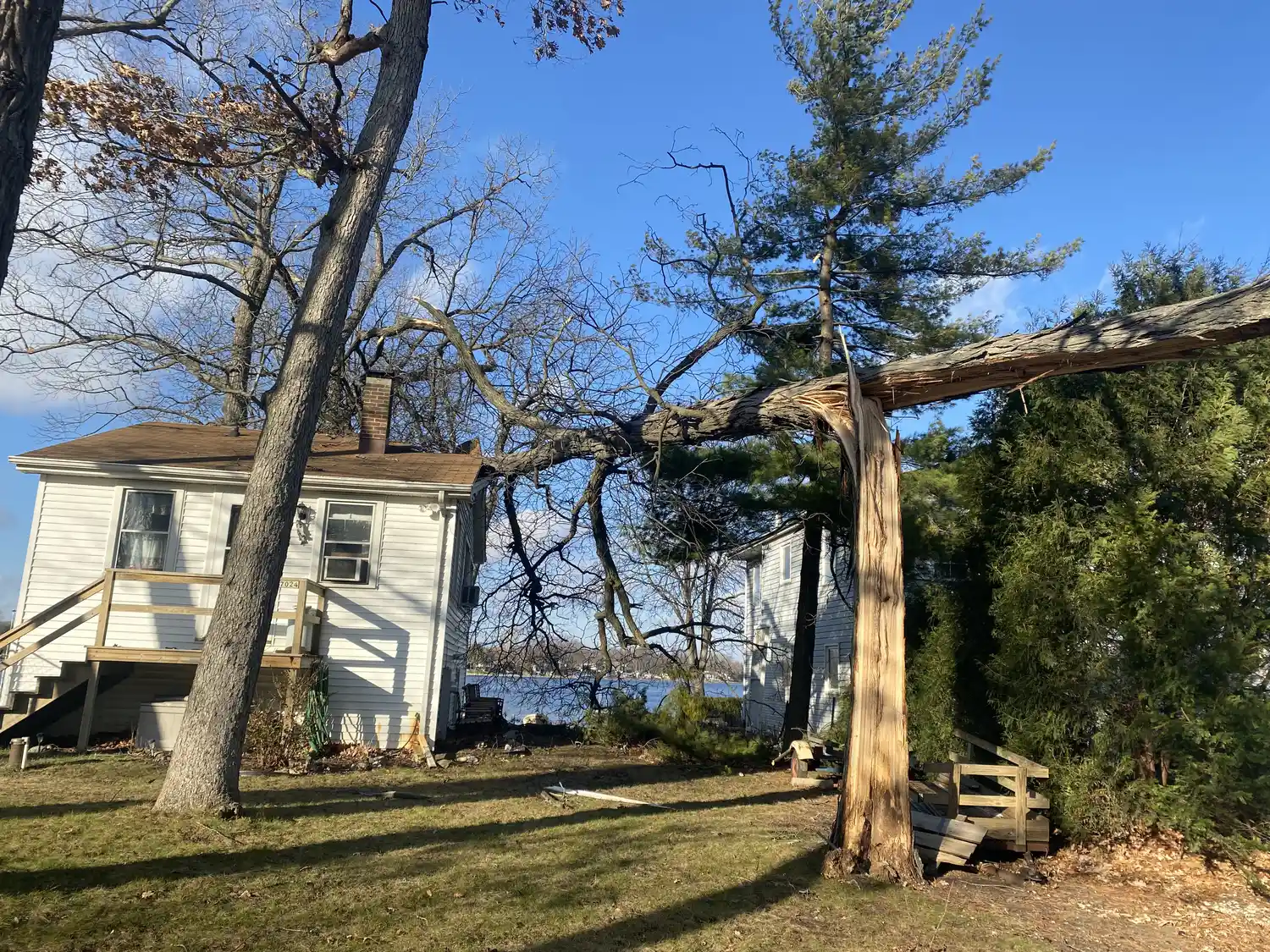
For trees that are already declining, removal is the safer and more practical choice. A dead or dying ash becomes brittle quickly. The wood dries out and branches start snapping in moderate wind. Every winter storm in New Berlin brings calls from homeowners who waited too long and now have a half-dead ash leaning toward the house or tangled in power lines.
What Happens If You Wait
The structural integrity of an EAB-killed ash deteriorates faster than most people expect. Within two years of death, the wood becomes punky and unpredictable. Limbs that look solid can snap under their own weight. The root system, no longer maintained by a living tree, begins to rot, and the entire tree becomes a fall risk.
Removal of a standing dead ash costs more than removing one that’s still alive. Dead wood is harder to cut predictably, and the risk of pieces breaking off during the job means the crew has to take extra precautions. Waiting doesn’t save money. It adds to the final bill and adds risk to your property in the meantime.
When to Call a Professional
If you have ash trees on your New Berlin property and you’re not sure what condition they’re in, a professional assessment is the place to start. Russ Tree Service works throughout New Berlin, from Highland Terrace to Kohler Ridge, and we’ve been dealing with EAB removals across Waukesha County for years.
We can tell you whether your tree is a candidate for treatment or whether it’s time to take it down safely. If the situation is urgent, our 24/7 emergency service handles storm-damaged and failing trees around the clock.
If you’ve been putting off the ash tree question, the answer isn’t going to get easier. The beetles aren’t leaving, and the trees aren’t recovering on their own. Call us at (414) 422-9298 for a free estimate on tree removal or an honest assessment of what you’re working with.