If you’ve got a tree that needs to come down, you’ve probably thought about doing it yourself. Chainsaws aren’t hard to buy, YouTube has no shortage of tutorials, and paying someone a couple thousand dollars to cut down a tree feels steep when you’re standing in your own yard looking at it.
Some trees genuinely are DIY-appropriate. Others will put you in the hospital or through your neighbor’s fence. The line between the two isn’t always obvious, and the consequences of getting it wrong go well beyond a bad haircut on your landscaping.
What You Can Realistically Do Yourself
Small trees with a trunk diameter under about six inches, standing in an open area with no structures, fences, or power lines within falling distance, are reasonable DIY projects if you have a chainsaw and know how to use it. Ornamental trees, saplings, and small fruit trees fall into this category. You can notch the trunk, make your back cut, and let it fall into the open yard.
If the tree is small enough that you can physically push it over after cutting most of the way through the trunk, it’s a manageable job. That’s the practical test. If you can’t push it, you can’t control where it goes, and that’s where things get complicated.
Brush and branch cleanup after a storm is also DIY territory for most homeowners. Cutting up fallen limbs with a handsaw or chainsaw, dragging brush to the curb, splitting logs for firewood. That’s labor, not specialized skill.
Where DIY Becomes Dangerous
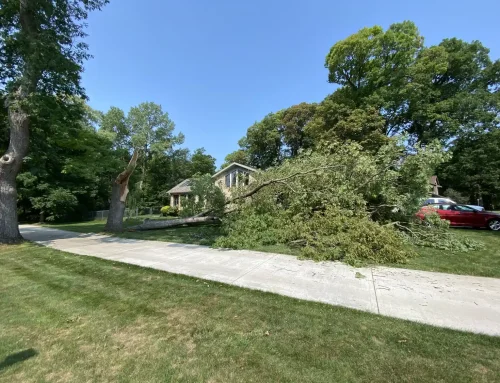
The moment a tree is large enough that you can’t predict or control its fall direction with certainty, you’re in professional territory. That’s most trees over about 20 feet tall or 10 inches in diameter, and any tree of any size that’s within striking distance of a house, garage, shed, fence, power line, or road.
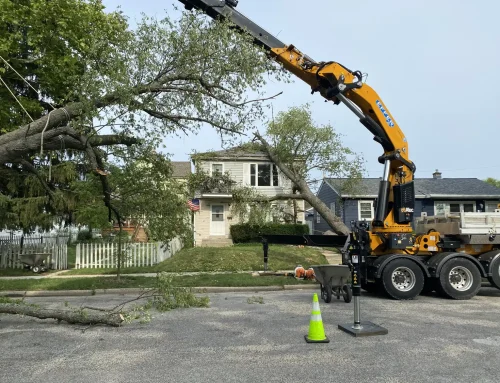
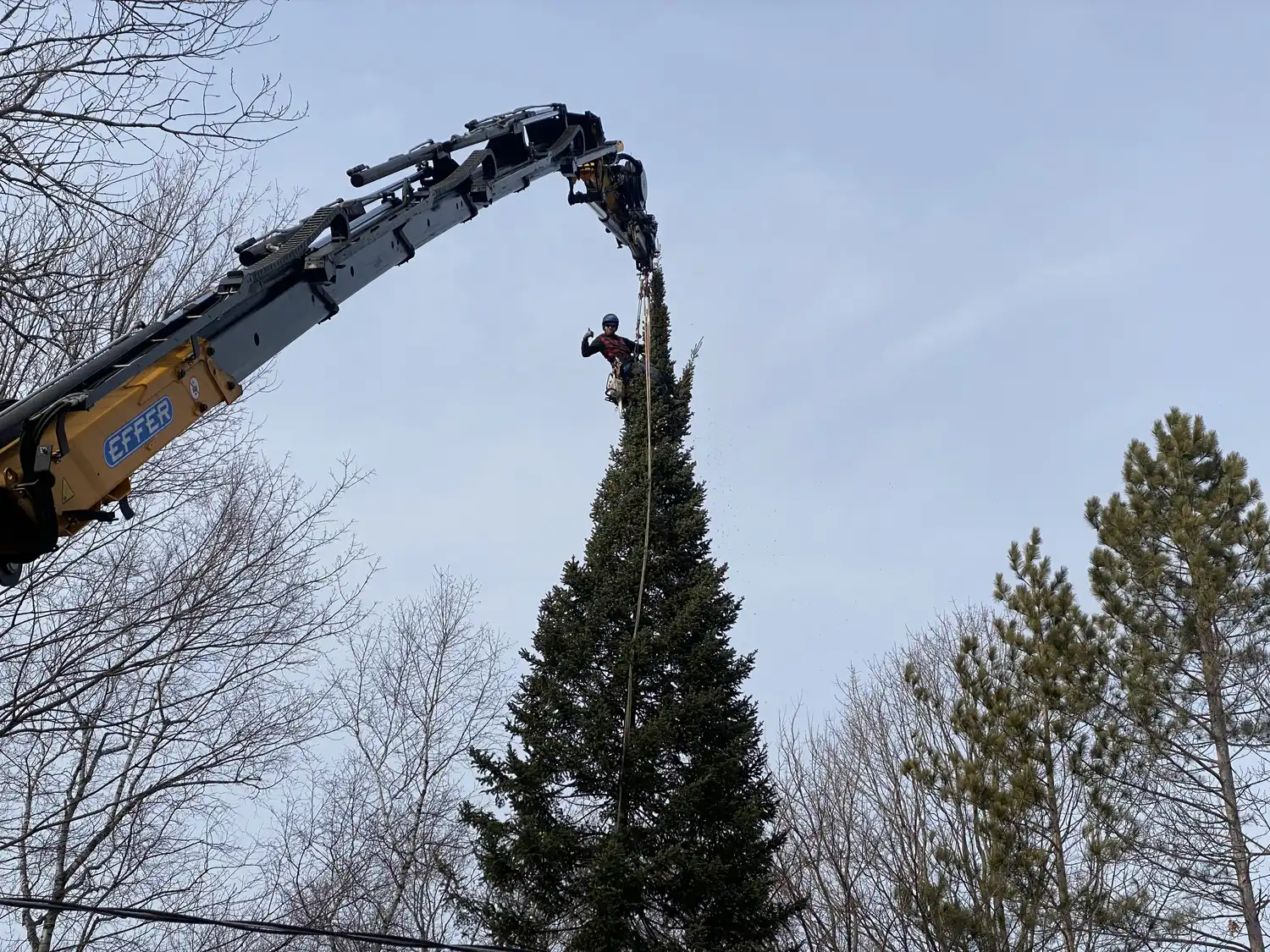
Trees near structures require directional felling or sectional removal from the top down. A tree doesn’t always fall where you expect it to. Even with a proper notch cut, wind, internal rot, uneven weight distribution, and branch loading can all redirect the fall. Professional crews use rigging systems to control exactly where every piece goes, and for tight spots they bring in a crane. That equipment and expertise exists because the margin for error is zero.
Trees near power lines are a non-negotiable call to a professional. Contact with a power line can kill you instantly, and it doesn’t require touching the line directly. Electricity can arc through a wet tree, a metal ladder, or a chainsaw. If any part of the tree could reach a power line during the fall, do not attempt it yourself.
Dead or leaning trees are unpredictable even for experienced arborists. Dead wood doesn’t flex the way live wood does, so the standard rules about notch cuts and hinge wood become unreliable. A dead tree can snap, twist, or barber-chair, which is when the trunk splits vertically instead of hinging at the cut, sending the top of the tree backward toward the person holding the saw. Dangerous trees require professional assessment before anyone picks up a chainsaw.
The Hidden Costs of DIY
Even when a tree is technically within DIY range, the full cost of doing it yourself is higher than most people calculate.
A decent chainsaw runs $300 to $600. Safety gear, including chaps, a helmet with face screen, hearing protection, and gloves, adds another $150 to $250 if you don’t already have it. If you need to rent a stump grinder, that’s $200 to $400 for a day. Disposal fees for hauling brush to the dump vary by municipality but can be $50 to $150 per load.
Add all that up and you might be spending $500 to $700 on a small tree removal that a professional would quote at $400 to $900, except the professional finishes in two hours, carries insurance, and doesn’t leave you with a chainsaw you’ll use once every five years.
The real hidden cost is time. Cutting down a tree is the fast part. Processing the branches, cutting the trunk into manageable pieces, splitting or stacking the wood, loading brush into a truck or trailer, making trips to the dump. For a medium-sized tree, that’s easily a full weekend.
The Middle Ground: Professional Cutting, DIY Cleanup
If your main motivation for doing it yourself is saving money, there’s an option that gives you most of the savings without any of the risk. Our Chop & Drop service handles the dangerous part, which is felling the tree, removing the limbs and leaving the wood on your property for you to deal with at your own pace.
You get professional cutting with proper equipment and insurance, and you handle the cleanup portion that doesn’t require specialized skills. The cost is 30 to 40 percent less than full-service removal because you’re taking on the labor-intensive but low-skill part of the job.
For a lot of homeowners in Waukesha County, this is the practical answer. The tree comes down safely, nobody’s standing under a leaning oak with a borrowed chainsaw, and you still save real money by doing the part you’re actually capable of doing.
Permits and Regulations
Before you remove any tree, whether yourself or through a service, check your local regulations. Some municipalities in southeast Wisconsin require permits for removing trees over a certain diameter, and the rules vary from town to town. New Berlin, for example, has specific requirements depending on the tree’s size and location on your property. Removing a protected tree without a permit can result in fines.
A professional tree service will know the local requirements and can advise you on whether a permit is needed. If you’re going the DIY route, call your city or village hall before you start cutting.
Make the Call That Fits Your Situation
If it’s a small tree in an open yard, do it yourself and save the money. If it’s anything near a structure or power line, or anything large enough that you can’t control the fall, call a professional. And if your main concern is cost, ask about Chop & Drop before you assume full-service removal is your only option.
Call Russ Tree Service at (414) 422-9298 for a free estimate. We’ll tell you honestly whether your tree is a DIY candidate or not, and if it’s not, we’ll give you options that fit your budget. We serve Muskego, New Berlin, Big Bend, Franklin, and the rest of southeast Wisconsin.